

Mt. Fuji outside of the climbing season
The climbing season for Mt. Fuji is typically as follows:
| Yamanashi Prefecture | Yoshida | July 1st - September 10th |
| Shizuoka Prefecture | Subashiri Trail | July 1st - September 10th |
| Gotemba Trail | July 10th to September 10th | |
| Fujinomiya Trail | July 10th to September 10th
(The section between the 6th and 6th stations will be from late June to early November.) |
Outside of the climbing season, all trails to the summit of Mt. Fuji are closed.
For safety reasonsAccording to Article 46 of the Road Act, the trail from Mt. Fuji 5th station to the summit is "prohibited from use."Has become.
(Only the Fujinomiya Trail during certain periods runs from the 6th station to the summit)
If you violate the rules,Imprisonment for six months or less or a fine of 300,000 yen or less.You may be subject to punishment.
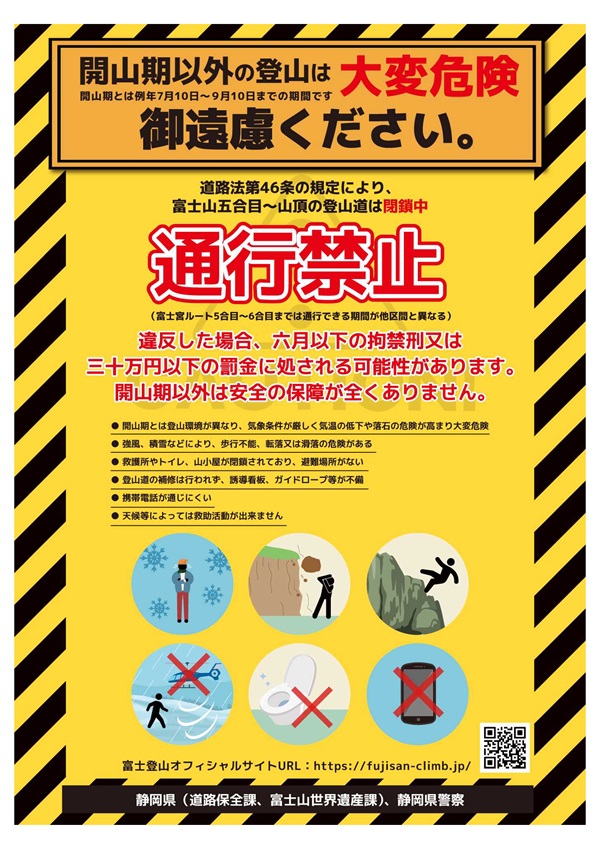
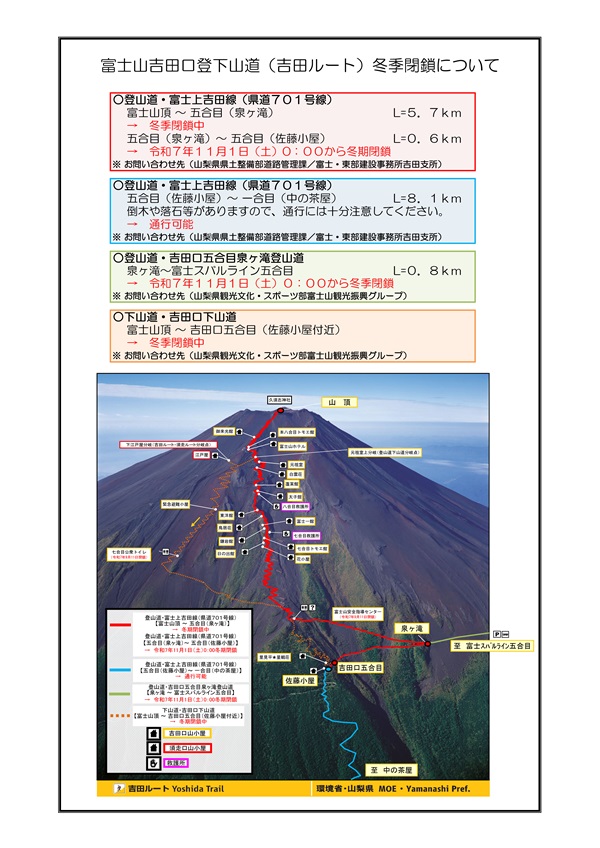 Yamanashi Prefecture: Information leaflet regarding restrictions outside of the mountain climbing season (353KB)
Climbing Mount Fuji outside of the designated climbing season is extremely dangerous.
The climbing season for Mt. Fuji (from the 5th station upwards) is as described above; the trail is closed at all other times.
During the mountain closure period, the First-aid Center and mountain huts are closed. Mt. Fuji is prone to severe weather conditions, with frequent blizzards and strong gusts of wind, making it extremely dangerous and posing a very high risk of mountain accidents.
The cause of the accident was,
- Lack of weather and other information
- Tourist mood
- Not adequately equipped
- Lack of knowledge and experience
- Unreasonable climb(I.e.or a packed schedule
- Overconfidence that one will not cause an accident
There are various things like that.
Even experienced mountain climbers who were supposed to have the knowledge and equipment have been involved in fatal accidents.
Risk Information
For details about Mt. Fuji during its closed season, please see the following section, "Mt. Fuji outside of the climbing season."
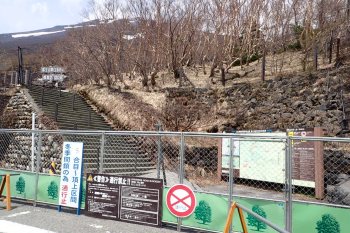
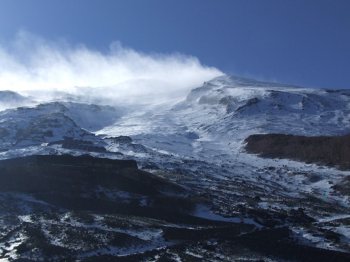
The appearance of Mt. Fuji outside of the climbing season.
Outside of the climbing season, there is absolutely no guarantee of safety.
First, please understand that unlike the summer climbing season, the mountain transforms into a dangerous place where even experts with specialized knowledge, equipment, experience, and physical fitness can get lost.
The basic weather conditions are completely different during the summer climbing season compared to other times of the year.
The graph shows the trend of the daily minimum temperature (ten-day average) at the summit of Mt. Fuji from 2022 to 2024. As you can see, temperatures are below freezing for most of the time the mountain is closed, and it is especially cold from November to April, with temperatures below -10°C. While temperatures appear to be milder during other periods, there is a risk of avalanches and falls due to rising temperatures in May and June, and the risk of hypothermia is extremely high in September and October, combined with typhoons and prolonged autumn rains.
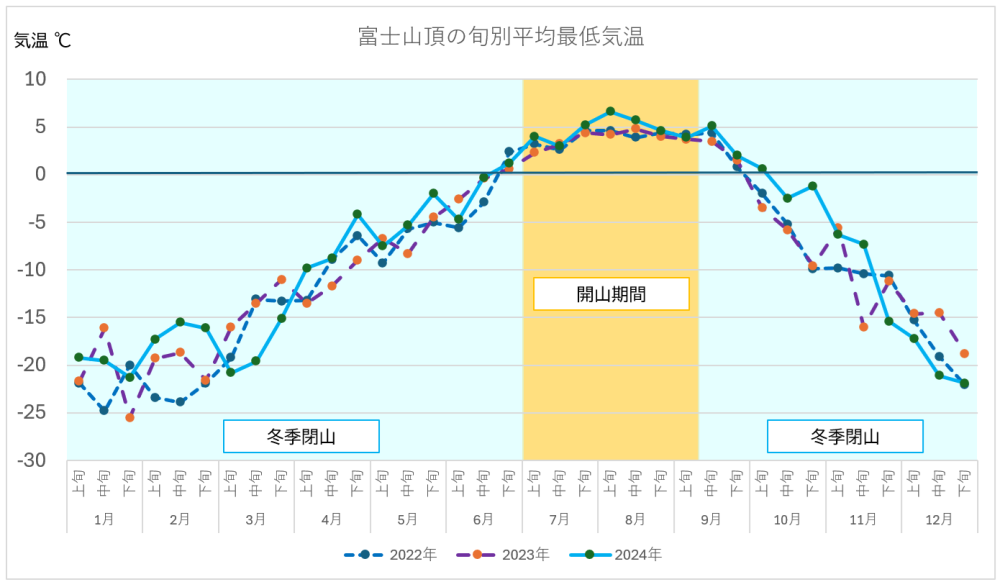
Average minimum temperature at the summit of Mt. Fuji by ten-day period
Data source: Japan Meteorological Agency website
Note: This does not mean that temperatures will never drop below freezing during the summer climbing season. The average temperature for each season is simply above freezing, but temperatures can still drop below freezing even during the climbing season, and icicles can form in the summit crater.
2) Severe weather conditions – wind
Furthermore, outside of the climbing season, the wind speed is even more challenging than the temperature on Mt. Fuji. It's said that the average wind speed is over 15 m/s, and maximum wind speeds can exceed 40 m/s. It's not uncommon for scoria pebbles to fly and hit your face or eyes, or for sand and snow to swirl up, obscuring your vision. There's also the risk of falling due to strong gusts of wind or slipping on icy patches. (Especially in early spring, many accidents occur, some resulting in fatalities.)
3) The facility is unavailable.
Facilities such as the First-aid Center, toilets, and mountain huts are closed during the winter. Therefore, they cannot be used as shelters. In the past, there have been incidents where someone broke into the 5th station facilities during the winter closure and set them on fire, and illegally entered mountain huts and stole valuables, both of which are clear criminal acts.
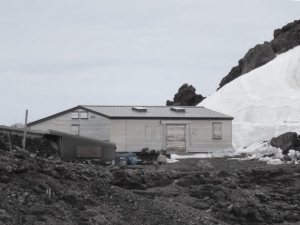
Mountaintop public toilets: Closed during winter
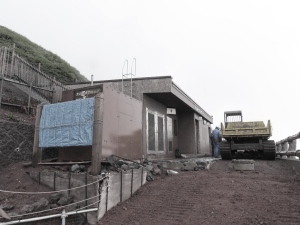
Yoshida Traildescending trail 7th station public toilet: Closed in winter
4) Trails are not maintained
During the climbing season, landslides caused by typhoons or other storms, or trails that become difficult to walk on, are promptly repaired. However, after the season closes, no trail maintenance is carried out for climbing. Furthermore, guide signs, maps, and guide ropes that are commonly seen during the climbing season are removed or put away for winter, and the safety of climbers is not ensured. In addition, the lack of trail maintenance increases the probability of rockfalls, raising the risk to human life.
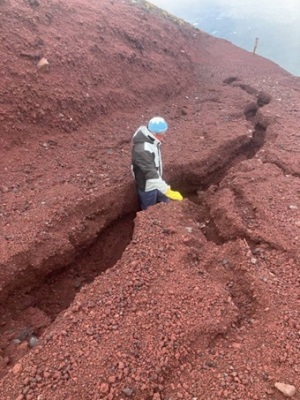
During the mountain's opening season, September 5, 2025, immediately after a landslide caused by a typhoon (Yoshida Trail) [Provided by Yamanashi Prefecture]
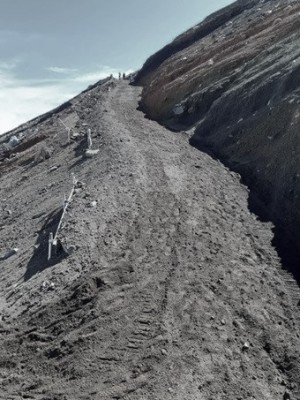
During the mountain opening period, after trail restoration on September 6, 2025 (Yoshida Trail) [Provided by Yamanashi Prefecture]
During the climbing season, trails are quickly prepared, but during the closed season, no trails are prepared for climbers at all.
5) Cell phone reception is poor.
During the summer climbing season, many hikers visit the area, so mobile phone carriers increase their base station capacity to cope with the influx. However, once the climbing season ends, the power to the facilities is shut off, and the additional base stations are removed, resulting in almost no mobile phone service.
6) Unable to go to rescue
Even if a rescue incident occurs, severe weather conditions can make rescue operations difficult. Furthermore, not only the person in distress but also the rescuers are put at risk.
"I'll be fine."
"It's okay because it's your own responsibility."
"Everyone else is going, so it's okay for me to climb it too."
Please refrain from attempting mountain climbing with such a simplistic mindset, as it is extremely dangerous.
The state of Mt. Fuji outside of the climbing season (from the perspective of disruption and nuisance)
Up to this point, I have explained six points from the perspective of "protecting lives." There is one more point I would like you to be aware of.
Even after reading this explanation, some people might think, "Even if it's impossible during the peak of winter, surely I can go just before the mountain opens or just after it closes?" However, the period before and after the mountain opens is a precious time necessary for the maintenance of Mt. Fuji's various facilities, such as repairing and renovating mountain huts and constructing diversion dams. The planned construction work must be completed within this limited period outside of the peak of winter, while also taking weather into consideration. What about hikers climbing up while the trail in front of the mountain huts is blocked and vehicles carrying materials are passing by? It would hinder the work and be a "nuisance" to Mt. Fuji.
This is an important maintenance task for the coming year, so we would appreciate your understanding.
Guidelines for ensuring safety when climbing Mt. Fuji
As mentioned earlier, there are regulations under the Road Act, but it is also true that some people with sufficient knowledge, experience, and physical strength attempt to climb Mt. Fuji during its closed season at their own risk, and accidents resulting from this have occurred.
From a safety standpoint, we absolutely do not recommend climbing Mt. Fuji outside of the climbing season. While the trails are closed outside of the climbing season and people are urged to refrain from climbing, in reality, some people still break through the closures and climb under their own discretion, and if they end up in trouble, mountain rescue personnel will have to risk their own lives to go and rescue them if a rescue request is made.
To prevent such accidents and preserve the natural environment, the "Guidelines for Ensuring Safety During Mount Fuji Climbing" (primarily concerning precautions outside of the summer climbing season) were established in 25.
On Mt. Fuji, there are rules in place, including a ban on climbing outside of the summer season for climbers who are not fully prepared. Please abide by these rules. The main points are as follows:
- Climbing outside of the summer season is prohibited for climbers who are not fully prepared.
- Outside of the summer mountain climbing season, you must create and submit a "Mountain Climbing Plan."
- Outside of the summer mountain season when mountain toilets are unusable, fully prepared climbers must carry a portable toilet, collect their own waste, and take it with them.
Guidelines for ensuring safety during Mount Fuji climbs (revised March 2021)
Guidelines (leaflet version) Japanese version・English version・Chinese (traditional) version・Simplified Chinese version・Korean version・Portuguese version
Inquiries and questions
▪️For inquiries and questions regarding the guidelines, please contact us at the address below.
Yamanashi Prefecture Tourism, Culture and Sports Department, Mt. Fuji Tourism Promotion Group
Phone: 055-223-1315
Shizuoka Prefecture, Sports and Culture Tourism Department, Mt. Fuji World Heritage Division
Phone: 054-221-3747
Ministry of the Environment, Kanto Regional Environment Bureau, Fuji-Hakone-Izu National Park Management Office
Phone: 0460-84-8727